
Tailored network infrastructure solutions for telecom carriers, enterprises, data centers, and industrial IoT environments.
Solutions by Vertical

Complete access layer solutions supporting GPON, XGS-PON, and Ethernet aggregation. Designed for service providers deploying FTTH, FTTB, and enterprise Ethernet services with centralized subscriber management and TR-069 provisioning.
Key products: OLT platforms, managed access switches, aggregation routers
Request Consultation
End-to-end campus LAN architectures featuring core, distribution, and access tier switches with SD-WAN overlay for branch connectivity. Unified wireless management and policy-based access control included.
Key products: L3 core switches, PoE access switches, Wi-Fi 6 APs, SD-WAN gateways
Request Consultation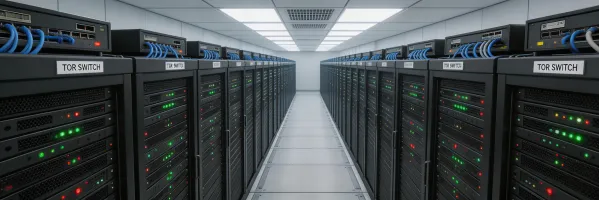
Spine-leaf and top-of-rack switch architectures with 25G/100G connectivity. Low-latency forwarding, EVPN-VXLAN fabric, and programmable APIs for DevOps-driven network automation.
Key products: 100G spine switches, 25G ToR switches, network automation platform
Request Consultation
IP67-rated managed switches and industrial routers for OT/IT convergence. Support for PROFINET, Modbus TCP, and time-sensitive networking (TSN) for deterministic industrial communication.
Key products: Industrial managed switches, DIN-rail routers, media converters
Request ConsultationOur equipment integrates with existing Cisco, Juniper, and Arista infrastructure through standard protocols (LLDP, BGP, OSPF, LACP), eliminating vendor lock-in.
Modular hardware platforms with software license upgrades allow you to start small and scale capacity without forklift replacements.
Every solution engagement includes a dedicated project manager and post-deployment support plan with defined SLAs and escalation paths.
Choosing the right network architecture involves trade-offs. We present both sides so you can make informed decisions aligned with your operational priorities.
This remains one of the most consequential decisions in enterprise and carrier network design. Each approach carries distinct advantages depending on organizational maturity and operational requirements.
Single-vendor integrated approach: Provides a unified management plane, a single point of support accountability, and proven interoperability between components. Deployment timelines are typically 30-40% shorter due to pre-validated configurations. However, this approach creates dependency on one vendor's product roadmap and pricing structure.
Open/disaggregated approach: Avoids vendor lock-in by enabling best-of-breed component selection. White-box switches running SONiC or OpenConfig can reduce hardware costs by 20-50% at scale. The trade-off is increased integration complexity, fragmented support channels, and higher demand for in-house networking expertise.
Adtran supports both models: our equipment runs standard protocols for multi-vendor environments, while our NMS platform provides single-pane management for all-Adtran deployments.
For service providers deploying fiber access networks, the choice between AON and PON architectures involves balancing bandwidth guarantees against deployment economics.
Active Optical Networks: Deliver dedicated bandwidth per subscriber with reach up to 80 km using powered equipment at each split point. AON provides easier fault isolation and per-port monitoring, making it preferable for enterprise-grade SLA requirements. Operational costs are higher due to powered field equipment requiring maintenance and electricity.
Passive Optical Networks: Use unpowered optical splitters, reducing outside plant complexity and operational expenditure. GPON and XGS-PON offer shared bandwidth that is sufficient for most residential and SMB deployments. PON economics favor high-density areas where the cost per subscriber drops below $150 for outside plant.
Adtran offers both OLT platforms for PON deployments and managed access switches for active Ethernet architectures, allowing operators to deploy the optimal technology per service area.